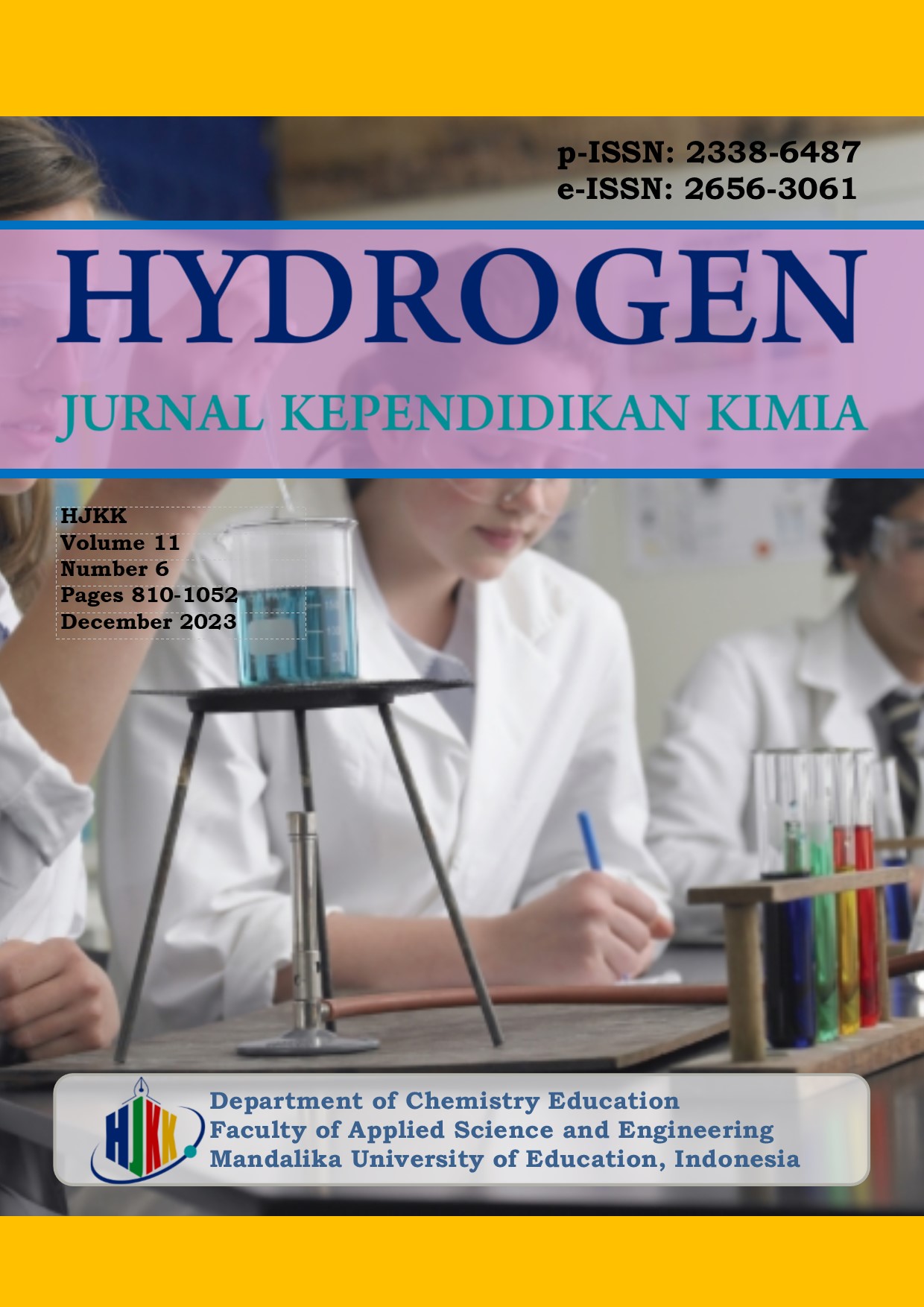
Preliminary Study: Study of Supporting Facilities for Natural Science Mini Project Practicum Models of Junior High Schools in Mataram
DOI:
https://doi.org/10.33394/hjkk.v11i6.9420Keywords:
supporting facilities, laboratory equipment, chemicals, PIMPA modelAbstract
This study aims to describe the supporting facilities for the Natural Science Mini Project Practicum (PIMPA) model of learning from the availability of tools and chemicals as well as books or literature available in SMP throughout Mataram City. This research was conducted in three schools spread outside the urban areas of Mataram City, especially those located close to the tourism area of Mataram City, namely: SMPN 11 Mataram, SMPN 17 Mataram, and SMPN 21 Mataram. The research subjects were laboratories and libraries, and the research objects were laboratory support facilities. The form of activity carried out is the recording of documents (inventory) of laboratory equipment and their use in science practicum activities. The data from this study were analyzed descriptively qualitatively. The results of this study indicate that the laboratory carrying capacity in the PIMPA model is the availability of laboratory equipment for science practicum activities at SMPN 11 Mataram is 77.27% (adequate); SMPN 17 Mataram available 77.27% (adequate); and SMPN 21 Mataram available 72.72% (adequate).Â
References
Anggareni, NW, et al. " Implementation Strategy Learning Inquiry To Ability Think Critical And Understanding Science Concepts for Middle School Students." Journal of Science Education Ganesha , vol. 3, no. 1, 2013.
Anggraini, A. (2016). Development of Biology Practicum Instructions on Mushrooms with Empowerment Patterns of Thinking Through Questions (Case Study in Class X.3 of Muhammadiyah 1 Metro High School 2015 Academic Year. BIOEDUCATION, 7 (1), 73-80. http://doi.org/10.24127/bioedukasi.v7i1.494
Ardiansyah, B., Sarjan, M., & Hakim, A. (2022). Science Practicum and Mini Edupark School (MES) As Alternatives To Improve Environmental Care Attitude In Philosophy Perspective. JUSTEK: Journal of Science and Technology, 5 (2), 117-124. http : // doi.org/10.31764/justek.vXiY.ZZZ
Cantona, I., & Sudarma, I. (2020). The SAVI Learning Model Assisted by Mind Mapping Media Improves Science Learning Outcomes of Grade V Students. Journal of Pedagogy and Learning, 3 (2), 269-279. https://doi.org/10.23887/jp2.v3i2.26615
Creswell, J. (2020). Qualitative Research & Research Design (translation). Yogyakarta: Student Libraries.
Dewi , NLPR, Suastra , IW, & Pujani , NM (2019). Development of Contextual Middle School Science Practicum Modules on Material Pollution Environment For Increase Science Process Skills and Character Care Environment . Indonesian Values and Character Education Journal, 1 (2), 57–67. https://doi.org/10.23887/ivcej.v1i2.20314 .
Faiz, A., Pratama, A., & Kurniawaty, I. (2022). Differentiated Learning in the Driving Teacher Program in Module 2.1. BASICEDU JOURNAL, 6 (2), 2846 - 2853. https://doi.org/10.31004/basicedu.v6i2.2504
Fatimah, S. (2017). Analysis of Understanding Science Concepts Based on Learning Motivation, Science Process Skills, Multipretation Ability, Gender, and School Background of Elementary Teacher Prospective Students. Journal of Elementary School Education and Learning Innovation, 1 (1), 57-70. https://doi.org/10.24036/jippsd.v1i1.7934
Hakim.A, Liliasari, Kodarohman.A, & Maolana.SY. (2016). Improvement of Student Critical Thinking Skills With The Natural Product Mini Project Laboratory Learning. Indonesian Journal of Chemistry, 16 (3), 322-328. https://doi.org/10.22146/ijc.21149
Candra, R., & Hidayati , D. (2020). Application Practice in Increase Process and Work Skills Participant Educated in the Science Laboratory. Edutama : Journal Educational And Social Religion , 6 (1), 26-37 . https://doi.org/10.32923/edugama.v6i1.1289
I Dris , N., Talib, O., & Razali, F. (2022). Strategies in Mastering Science Process Skills in Science Experiments: A Systematic Literature Review. Indonesian Journal of Science Education, 11 (1), 155-170. https://doi.org/10.15294/jpii.v11i1.32969 .
Lin, S., & Chiu, C.-K. (2020). Heuristic Projects in Open Learning Environments: Time Phase in Individual and Collective Determinants. Eurasia Journal of Mathematics, Science and Technology Education, 16 (1), em1797. https://doi.org/10.29333/ejmste/112247 .
Maknun , D., HK Surtikanti , R., & Subahar , T. (2012). MAPPING OF LABORATORY ESSENTIAL SKILLS IN ECOLOGY PRACTICE ACTIVITIES. Journal of Indonesian Science Education, 1 (1). doi : https://doi.org/10.15294/jpii.v1i1.2003
Nisa, U. (2017). Practicum Methods for Improving Understanding and Learning Outcomes of Class V MI YPPI 1945 Tripe on Single and Mixed Substance Materials. Semarang: Proceedings of Biology Education Conference.
Nurmilawati, M., & Rahmawati, I. (2018). Identifying Skills in the Mini Project Based Plant Morphology Course. Madiun: Proceedings of the SYMBIOSIS National Seminar III.
Pertiwi, F. (2019). Management System (Planning, Implementation, Evaluation) of State Middle School Science Laboratory in Ponorogo. Codification: Journal of Islamic Research, 13 (1), 89-106. http://dx.doi.org/10.21154/kodifikasia.v13i1.1704
Ratnasari, B., Haris, A., & Azis, A. (2021). Study of Physics Higher Order Thinking Ability in High School. Journal of Science and Physics Education (JSPF), 17 (1), 57-68. http://dx.doi.org/10.35580/jspf.v17i1.19063
Setiawati, G., & Ekayanti, N. (2021). Playing Science as an Effective Method in Science Learning for D - aged Children. Pratama Widya : Journal of Early Childhood Education, 6 (2), 126-136. https://doi.org/10.25078/pw.v6i2.2391
Solé-Llussà , Aguilar, D., & Ibáñez, M. (2022). The Effect of an Instructional Intervention Based on the Use of Video Worked Examples to Promote Elementary Students' Science Process Skills. International Journal of Education in Mathematics, Science, and Technology (IJEMST), 10 (3), 753-772. https://doi.org/10.46328/ijemst.2158
Sugiyono. (2016). Quantitative Research Methods, Qualitative, and R&D. . Bandung: CV Alphabet.
Suryaningsih, Yeni "Learning based Practice as Means Student For Train Apply Science Process Skills in Material Biology." Bio Educatio, vol. 2, no. 2, 2017. http://dx.doi.org/10.31949/be.v2i2.759
Trisusilosakti, A., & Aisyah, R. (2020). Mini-Project-Based Chemistry Laboratory Activities Against Learning Outcomes and Student Activities in the Aldehyde Test Practicum. Jambura Journal of Educational Chemistry, 2 (1), 1-9. https://doi.org/10.34312/jjec.v2i1.2681
Yuliati, Y. (2016). Improving Elementary School Students' Science Process Skills Through Problem-Based Learning Models. Journal of Pendas Cakrawala, 2 (2). http://dx.doi.org/10.31949/jcp.v2i2.335
Downloads
Additional Files
Published
How to Cite
Issue
Section
License
License and Publishing Agreement
In submitting the manuscript to the journal, the authors certify that:
- They are authorized by their co-authors to enter into these arrangements.
- The work described has not been formally published before, except in the form of an abstract or as part of a published lecture, review, thesis, or overlay journal.
- That it is not under consideration for publication elsewhere,
- That its publication has been approved by all the author(s) and by the responsible authorities – tacitly or explicitly – of the institutes where the work has been carried out.
- They secure the right to reproduce any material that has already been published or copyrighted elsewhere.
- They agree to the following license and publishing agreement.
Copyright
Authors who publish with Hydrogen: Jurnal Kependidikan Kimia agree to the following terms:
- Authors retain copyright and grant the journal right of first publication with the work simultaneously licensed under a Creative Commons Attribution License (CC BY-SA 4.0) that allows others to share the work with an acknowledgment of the work's authorship and initial publication in this journal.
- Authors are able to enter into separate, additional contractual arrangements for the non-exclusive distribution of the journal's published version of the work (e.g., post it to an institutional repository or publish it in a book), with an acknowledgment of its initial publication in this journal.
- Authors are permitted and encouraged to post their work online (e.g., in institutional repositories or on their website) prior to and during the submission process, as it can lead to productive exchanges, as well as earlier and greater citation of published work.
Licensing for Data Publication
Hydrogen: Jurnal Kependidikan Kimia uses a variety of waivers and licenses, that are specifically designed for and appropriate for the treatment of data: Open Data Commons Attribution License, http://www.opendatacommons.org/licenses/by/1.0/ (default) Other data publishing licenses may be allowed as exceptions (subject to approval by the editor on a case-by-case basis) and should be justified with a written statement from the author, which will be published with the article.