Reducing Coffee Acidity and Caffeine through the Roasting Method using Azadirachtaindica Firewood
DOI:
https://doi.org/10.33394/hjkk.v12i3.12140Abstract
Coffee is known as an acidic drink, so it will make the stomach feel unpleasant. This research compares the roasting method with Azadirachta Indica firewood with machine and manual roasting processes. Each roasting method uses four maturity levels: light roast, medium roast, dark roast, and extra dark roast. The acidity test used a pH meter instrument, and the caffeine test used the spectrophotometric method, which was carried out at the Sucofindo Indonesia laboratory. The one-way ANOVA test analyzed each method's acidity and caffeine results statistically. It can be seen that the sig < 0.05 in one-way ANOVA results for pH (0.006) and caffeine (0.013) coffee tests. So, there are significant differences in the three coffee roasting methods in reducing acidity and caffeine levels at each coffee roasting level. The average results of coffee acidity using the Azadirachta Indica wood roasting method (5.6), machine roasting (5.1), and manual roasting (4.8). The average yield of coffee caffeine with the Azadirachta Indica wood roasting method (2.13), machine roasting (2.55), and manual roasting (2.90). The roasting way using Azadirachta Indica firewood is the most effective, and there is a significant difference in reducing the acidity and caffeine of coffee at each level of coffee roasting. 55), and manual roasting (2.90). The most effective method of roasting is with Azadirachta Indica firewood, and there are significant differences in reducing the acidity and caffeine of coffee at each coffee roasting level. 55), and manual roasting (2.90). The most effective method of roasting is with Azadirachta Indica firewood, and there are significant differences in reducing the acidity and caffeine of coffee at each coffee roasting level.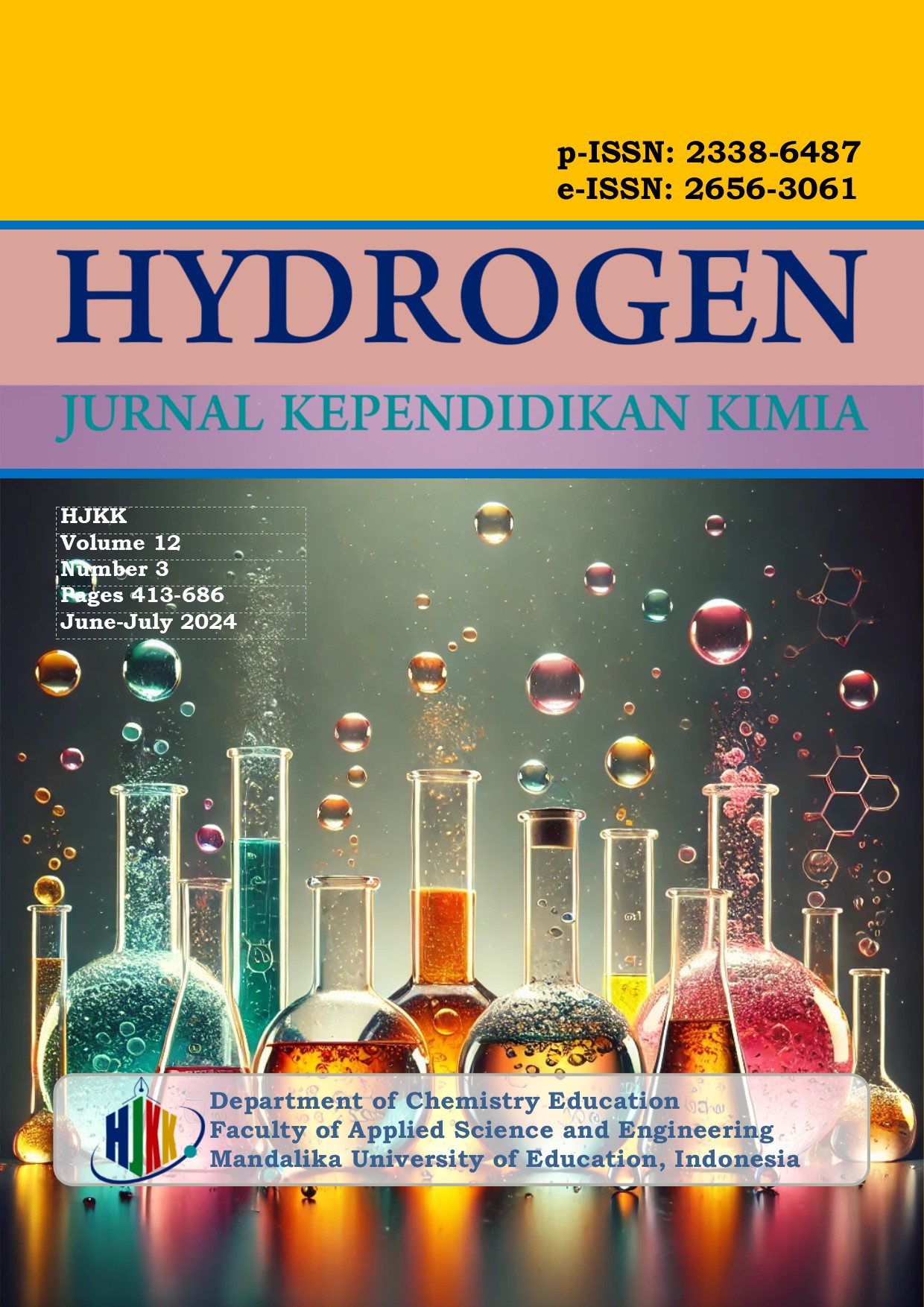
Downloads
Additional Files
Published
2024-07-05
How to Cite
Putera, D., Yamin, Y., & Firdaus, T. (2024). Reducing Coffee Acidity and Caffeine through the Roasting Method using Azadirachtaindica Firewood. Hydrogen: Jurnal Kependidikan Kimia, 12(3), 512–525. https://doi.org/10.33394/hjkk.v12i3.12140
Issue
Section
Articles
License
License and Publishing Agreement
In submitting the manuscript to the journal, the authors certify that:
- They are authorized by their co-authors to enter into these arrangements.
- The work described has not been formally published before, except in the form of an abstract or as part of a published lecture, review, thesis, or overlay journal.
- That it is not under consideration for publication elsewhere,
- That its publication has been approved by all the author(s) and by the responsible authorities – tacitly or explicitly – of the institutes where the work has been carried out.
- They secure the right to reproduce any material that has already been published or copyrighted elsewhere.
- They agree to the following license and publishing agreement.
Copyright
Authors who publish with Hydrogen: Jurnal Kependidikan Kimia agree to the following terms:
- Authors retain copyright and grant the journal right of first publication with the work simultaneously licensed under a Creative Commons Attribution License (CC BY-SA 4.0) that allows others to share the work with an acknowledgment of the work's authorship and initial publication in this journal.
- Authors are able to enter into separate, additional contractual arrangements for the non-exclusive distribution of the journal's published version of the work (e.g., post it to an institutional repository or publish it in a book), with an acknowledgment of its initial publication in this journal.
- Authors are permitted and encouraged to post their work online (e.g., in institutional repositories or on their website) prior to and during the submission process, as it can lead to productive exchanges, as well as earlier and greater citation of published work.
Licensing for Data Publication
Hydrogen: Jurnal Kependidikan Kimia uses a variety of waivers and licenses, that are specifically designed for and appropriate for the treatment of data: Open Data Commons Attribution License, http://www.opendatacommons.org/licenses/by/1.0/ (default) Other data publishing licenses may be allowed as exceptions (subject to approval by the editor on a case-by-case basis) and should be justified with a written statement from the author, which will be published with the article.