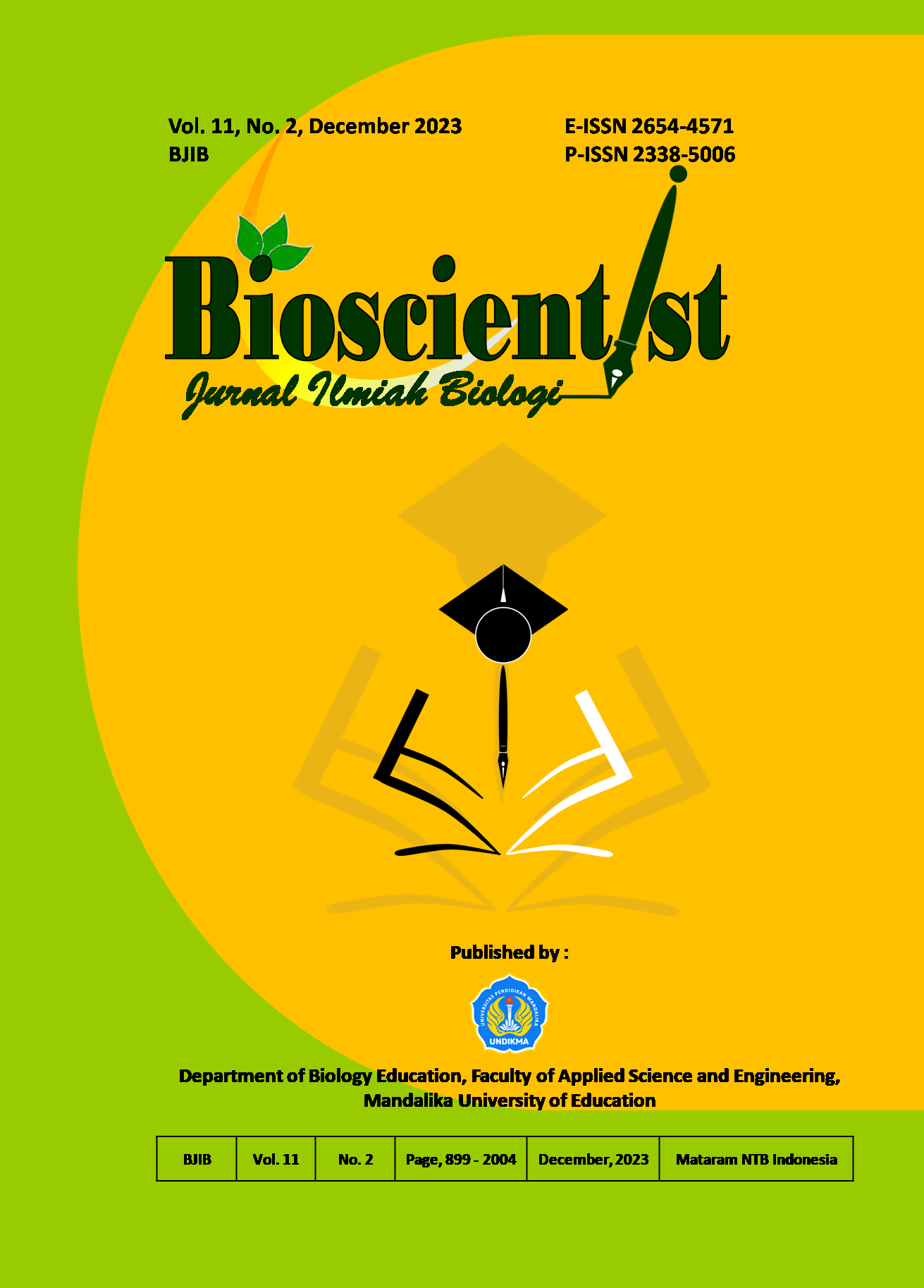
Pengaruh Pemberian Beberapa Jenis Yogurt Komersial terhadap Jumlah Profil Darah Tikus (Rattus norvegicus) yang Diinduksi Diabetes Melitus
DOI:
https://doi.org/10.33394/bioscientist.v11i2.9398Keywords:
Diabetes Mellitus, Blood Profile, Yogurt.Abstract
Diabetes mellitus is a metabolic disorder that occurs due to inadequate insulin levels or insulin resistance which leads to hyperglycemia. Handling hyperglycemia conditions in diabetes mellitus is very necessary, one of which is by consuming healthy and nutritious food. The aim of this research is to determine the results of total antioxidant levels in types of yogurt which can have an influence on the blood profile of white rats (Rattus norvegicus) with diabetes mellitus. This research used white rats (Rattus norvegicus) as experimental animals which were divided into 5 groups (K+: normal type, K-: negative type (alloxan), P1: type I yogurt brand (drinking yogurt), P2: type. yogurt brand II (yogurt set), P3: kel. yogurt brand III (stirred yogurt) with 5 treatment repetitions each. Yoghurt was given using the oral sonde technique to the experimental animals. Blood samples from the experimental animals were taken through the orbital sinus using hematocrit. Profile Rat blood was tested using a hematology analyzer. The data obtained were analyzed using one-way ANOVA and Duncan's test with a significance level of 0.05. Statistical results showed that there were significant differences (p < 0.05) in each treatment group. Based on the average results erythrocytes, hemoglobin, leukocytes and platelets that brand III yogurt samples had a better level of improvement than the others. This is also in line with the results of testing antioxidant levels in brand III yogurt, namely 51.38 ppm, which means the antioxidant levels are strong.References
Amjad, S., Jafri, A., Sharma, A. K., & Serajuddin, M. (2019). A Novel Strategy of Nanotized Herbal Drugs and Their Delivery in the Treatment of Diabetes: Present Status and Future Prospects. Journal of Herbal Medicine, 17-18(1), 1-10. https://doi.org/10.1016/j.hermed.2019.100279
Ardiani, H. E., Permatasari, T. A. E., & Sugiatmi, S. (2021). Obesitas, Pola Diet, dan Aktifitas Fisik dalam Penanganan Diabetes Melitus pada Masa Pandemi Covid-19. Muhammadiyah Journal of Nutrition and Food Science (MJNF), 2(1), 1-12. https://doi.org/10.24853/mjnf.2.1.1-12
Barengolts, E., Smith, E. D., Reutrakul, S., Tonucci, L., & Anothaisintawee, T. (2019). The Effect of Probiotic Yogurt on Glycemic Control in Type 2 Diabetes or Obesity: A Meta-Analysis of Nine Randomized Controlled Trials. Nutrients, 11(3), 6-8. https://doi.org/10.3390/nu11030671
Candrarisna, M., & Kurnianto, A. (2018). Aktivitas Ekstrak Kulit Mahkota Dewa (Phaleria macrocarpa) sebagai Teraupetik Diabetes Mellitus terhadap Glukosa Darah, Leukosit dan Hemoglobin pada Tikus yang Diinduksi Aloksan. Jurnal Ilmiah Kedokteran Wijaya Kusuma, 7(1), 38-50. https://doi.org/10.30742/jikw.v7i1.166
Handayani, E. S., Dianita, F. J., & Yuantari, R. Y. (2022). Pengaruh Durasi DM Tipe 2 terhadap Angka Leukosit dan Hitung Jenis Leukosit pada Tikus Wistar Pasca Bilateral Common Carotid Artery Occlusion (BCCAO). Smart Medical Journal, 5(1), 29-37. https://doi.org/10.13057/smj.v5i1.42787
Ighodaro, O. M., Adeosun, A. M., & Akinloye, O. A. (2017). Alloxan-Induced Diabetes, a Common Model for Evaluating the Glycemic-Control. Medicina, 53(6), 365-374. https://doi.org/10.1016/j.medici.2018.02.001
International Diabetes Federation. (2021). Retrieved October 15, 2023, from IDF Diabetes Atlas, 10th Edition. Interactwebsite: https://diabetesatlas.org/idfawp/resource-files/2021/07/IDF_Atlas_10th_Edition_2021.pdf
Kartikasari, D. M., Indahyani, D. E., & Praharani, D. (2020). Jumlah Trombosit pada Mencit Diabetes setelah Pemberian Ekstrak Rumput Laut Merah (Rhodophyceae). Pustaka Kesehatan, 7(3), 171-176. https://doi.org/10.19184/pk.v7i3.11350
Khairani. (2019). Retrieved October 15, 2023, from Hari Diabetes Sedunia Tahun 2018. Interactwebsite: https://p2ptm.kemkes.go.id/tag/hari-diabetes-sedunia-tahun-2018
Lestari., Zulkarnain., & Sijid, S. A. (2021). Diabetes Melitus: Review Etiologi, Patofisiologi, Gejala, Penyebab, Cara Pemeriksaan, Cara Pengobatan dan Cara Pencegahan. In Prosiding Biologi Achieving the Sustainable Development Goals with Biodiversity in Confronting Climate Change (pp. 237-241). Makassar, Indonesia: Universitas Islam Negeri Alauddin Makassar.
Mahmoud, A. M. (2013). Hematological Alterations in Diabetic Rats - Role of Adipocytokines and Effect of Citrus Flavonoids. EXCLI Journal, 12(1), 647-657.
Martemucci, G., Costagliola, C., Mariano, M., D’andrea, L., Napolitano, P., & D’Alessandro, A. G. (2022). Free Radical Properties, Source and Targets, Antioxidant Consumption and Health. Oxygen, 2(2), 48-78. https://doi.org/10.3390/oxygen2020006
Megawati, F., Agustini, N. P. D., & Krismayanti, N. L. P. D. (2020). Studi Retrospektif Terapi Antidiabetik pada Penderita Diabetes Melitus Rawat Inap di Rumah Sakit Umum Ari Canti Periode 2018. Jurnal Ilmiah Medicamento, 6(1), 28-32. https://doi.org/10.36733/medicamento.v6i1.718
Mohamadshahi, M., Veissi, M., Haidari, F., Javid, A. Z., Mohammadi, F., & Shirbeigi, E. (2014). Effects of Probiotic Yogurt Consumption on Lipid Profile in Type 2 Diabetic Patients: A Randomized Controlled Clinical Trial. Journal of Research in Medical Sciences, 19(6), 531-536.
Ningrum, N. A., & Wijayanti, N. (2020). Antioxidant Properties of Gomphrena globosa Leaves Extract. In The 6th International Conference on Biological Science ICBS 2019 (pp. 1-10). Yogyakarta, Indonesia: Universitas Gadjah Mada.
Palimbunga, D. P., Pandelaki, K., Mongan, A. E., & Manoppo, F. (2013). Perbandingan Jumlah Trombosit pada Pasien Diabetes Melitus Tipe 2 yang Menggunakan Aspirin dan Tidak Menggunakan Aspirin. Jurnal E-Biomedik, 1(1), 202-209. https://doi.org/10.35790/ebm.1.1.2013.1618
Puspita, N. D., Langi, Y. A., & Rotty, L. W. A. (2015). Hubungan Kadar Trombosit dan Kejadian Kaki Diabetik pada Penderita Diabetes Melitus Tipe 2. E-CliniC, 3(1), 363-367. https://doi.org/10.35790/ecl.3.1.2015.7388
Rahimi-Madiseh, M., Malekpour-Tehrani, A., Bahmani, M., & Rafieian-Kopaei, M. (2016). The Research and Development on the Antioxidants in Prevention of Diabetic Complications. Asian Pacific Journal of Tropical Medicine, 9(9), 825-831. https://doi.org/10.1016/j.apjtm.2016.07.001
Safnowandi. (2022). Pemanfaatan Vitamin C Alami sebagai Antioksidan pada Tubuh Manusia. Biocaster : Jurnal Kajian Biologi, 2(1), 6-13. https://doi.org/10.36312/bjkb.v2i1.43
Sakka, L., & Muin, R. (2023). Identifikasi Kandungan Senyawa Antioksidan Ekstrak Daun Bidara (Ziziphus mauritiana Lamk.) dengan Menggunakan Metode DPPH. Journal Syifa Sciences and Clinical Research, 4(1), 92-100. https://doi.org/10.37311/jsscr.v4i1.13518
Salas-Salvadó, J., Guasch-Ferré, M., DÃaz-López, A., & Babio, N. (2017). Yogurt and Diabetes: Overview of Recent Observational Studies. Journal of Nutrition, 147(7), 1452S-1461S. https://doi.org/10.3945/jn.117.248229
Syukriah., Azhari, M. B., Ningrum, N. A., & Amira, S. (2022). Uji Fitokimia dan Antioksidan Ekstrak Etanol Buah Terung (Solanum melongena) dengan Metode DPPH. JITek: Jurnal Ilmiah Teknosains, 8(2), 8-13. https://doi.org/10.26877/jitek.v8i2/Nov.13569
Thieu, V. T., Mitchell, B. D., Varnado, O. J., & Frier, B. M. (2020). Treatment and Prevention of Severe Hypoglycaemia in People with Diabetes: Current and New Formulations of Glucagon. Diabetes Obesity and Metabolism, 22(4), 469-479. https://doi.org/10.1111/dom.13941
Wang, Y., Yang, P., Yan, Z., Liu, Z., Ma, Q., Zhang, Z., Wang, Y., & Su, Y. (2021). The Relationship between Erythrocytes and Diabetes Mellitus. Journal of Diabetes Research, 2021(1), 1-9. https://doi.org/10.1155/2021/6656062
Webber, S. (2013). Five Questions on the IDF Diabetes Atlas. Diabetes Research and Clinical Practice, 102(2), 147-148. https://doi.org/10.1016/j.diabres.2013.10.013